Commodity Compass — Free Playbook

I was three signatures from closing a $1 billion deal. Here's everything I know.

A complete breakdown of commodity brokering — the market that's been quietly making people wealthy for decades, and why you can now do it without a finance degree, industry connections, or $30K software.

VIDEO SLOT: Ken's educational video embed
Replace this div with YouTube iframe once video is live
Before you read this

Treat this document like you paid $10,000 for it. Quiet room. Other tabs closed. Phone face-down. Read it in one sitting if you can, in pieces if you can't, and come back to whatever didn't land the first time. There's no quiz at the end. Nothing here will refresh while you read. Just slow down.

1. Why I'm writing this

Four years ago I stumbled into a market most people don't know exists. I almost made millions from it twice. I closed real deals. I lost real deals to tariffs and bombings. The whole picture has never been written down in one place — so I'm writing it down.

The people who know how this works don't talk about it. They're in their 50s, working at trading houses in Geneva and Singapore, with zero incentive to explain it to you. The younger generation doing it independently is scattered across WhatsApp groups and Discord servers, sharing deals in real time but never explaining the model.

This isn't a course. There's no upsell at the bottom. I'm building software for this market, and I want the model itself out in the open before the software launches. The more people doing this seriously, the more the whole network compounds. Worst case, you close the tab knowing more about how trillions of dollars actually move than 99% of people. Best case, you build a business off it.

Everything in this page comes from deals I actually worked, mistakes I actually made, and a community of 1,000+ people already doing this in real time. I'm going to show you the screenshots, the deal posts, the DMs. No illustrations. No stock photos. The real thing.

Read it if the idea of brokering physical commodities across markets sounds interesting. Close the tab if you're looking for something that pays out in 48 hours.

2. Who this is for. And who it isn't.

This is for you if:

  • You already have access to something valuable and don't know how to monetize it. A connection. A geographic position. A supply chain. A language. A niche product in your country that doesn't travel.
  • You built an AI agency (or tried to) and watched the model saturate under you. You did the work. The market just moved on.
  • You're stuck in the rat race and you're aware enough to know the next 5 years are going to look different from the last 5.
  • You're patient enough to work a 30-90 day deal cycle in exchange for commissions that pay out for 3 years after the deal closes.
  • You're willing to send cold messages, do research, and follow up. That's genuinely most of the job.

This isn't for you if:

  • You want to make money this week. Commodity deals take time. A fast deal is 30 days. A real deal is 60-90.
  • You're looking for passive income from day one. There's nothing passive about the first deal. After that, yes. Not before.
  • You need someone to hold your hand through every step. This page covers the model. Execution requires independent thinking.
  • You're not willing to learn the basic legal protection documents. Skip those and you're working for free.

3. I came within three signatures of a billion-dollar deal.

Before I tell you about that deal, you should know I'd been working this market for four years. My first commission check came at nineteen. I sourced heat-treated metals from China for a company that had been overpaying on the same product for years. Saved them half a million dollars. Earned my way in.

Since then I've worked deals in metals, agriculture, fuel, and specialty goods. I've built a network of suppliers, buyers, and brokers across more than twenty countries. The community we'll talk about later in this page started organizing around real deal flow before I'd written a single line of software for it.

That context matters. The next part is about losing. I don't want you reading it as "broker fails, here's a sad story." It's the opposite. It's the moment I realized how big this market actually is, and how close to it a regular person can get if they understand the model. Here's what happened.

The buyer was a Chinese state-owned enterprise. They needed non-GMO soybeans. One point two million metric tons. Over a billion dollars in product. They couldn't source from Brazil because of quality constraints. They couldn't source from Canada for political reasons. The US was the only option.

I had no background in agriculture. No connections in American farming. No idea what a grain bank was.

So I used an AI tool called Manus to scrape every soybean farmer and grain bank across the US, enriched the list with Apollo, and cold-called for three months straight. Eventually I found a network of US farmers who could collectively supply the volume.

We spent a month negotiating. I signed documents with the buyer. I signed documents with the supplier. We were three signatures from closing.

Then Trump signed an executive order on China tariffs.

The deal was dead within 48 hours. The Chinese buyer pulled out overnight. Millions in commissions. Gone.

"I freaked out. I nearly needed to get on meds. I'd been running my AI agency on the side this whole time. And I remember thinking: what the f*** am I running an agency for?"

— Ken, founder of Compass

The soybean deal didn't close. But it proved something bigger: this market is real. The money is real. A 24-year-old with no finance background, no industry connections, and a few AI tools can get close enough to a billion-dollar deal to lose sleep over it.

What I didn't have was the right infrastructure. The right tool. A platform built for how this actually works in 2026 instead of how it worked in 1995.

This page is everything I learned on the way there.

4. What commodity brokering actually is

Strip it down to its core: somewhere in the world, someone has something. Somewhere else in the world, someone needs it. The price they're paying right now is higher than what the supplier will accept. That gap is where the broker lives.

You don't own the product. You don't warehouse it. You don't ship it. You find the buyer. You find the supplier. You connect them, protect yourself legally, and you take a percentage of every transaction for the term of the agreement.

Buyer
Chinese SOE
Paying market rate + premium
You find them
Broker
You
10-15% spread, protected by contract
You find them
Supplier
US farmers
Selling below market without access to buyers

The gap between what the supplier will accept and what the buyer is paying is your commission. Once both parties sign your protection agreements, they're legally bound to pay you on every transaction between them for the contract term. Usually three years.

You close one deal. You get paid on it for 36 months.

That's the model.

5. The industry nobody talks about

The commodity trading world moves trillions of dollars a year. Most of it flows through a handful of firms you've probably never heard of: Vitol, Trafigura, Glencore, Cargill. These are not tech companies. They're not glamorous. They do not care about building an audience.

This industry has been gatekept by design. You entered it by spending 20 years at a trading house, building the relationships, earning the trust. Or you inherited it. Or you were in the right city at the right time and met the right person at 23.

I met the right person by accident. Before any of this happened I was 19, working minimum wage in security at a luxury retailer in the US. Then I packed up everything I owned and left the country. Eastern Europe was where I landed. No plan. No role waiting for me. I lived out of hotels at first. Eventually I stumbled into a network of industrialists in "boring" businesses (metals, chemicals, freight, equipment) who took me in because the young American wandering through their cities seemed interesting to them.

My first deal wasn't planned. One of the companies in that network was overpaying on heat-treated metals. I started helping them out around the edges. Research. Sourcing calls. Anything they needed an extra set of hands for. So I went looking for a cheaper source. Met a random guy at a bar. Got a WhatsApp number. Sourced metals from China. Saved the company $500,000 and got my first commission check.

I didn't even know the word "commodity broker" at the time.

"Anyone in the world is about two handshakes away from any source of commodity. You always know someone who knows someone."

— Ken's mentor, a Chinese industrialist

The man who said that ran a manufacturing operation that supplied components into industries most people don't think about. The kind of mid-stream operator who never shows up on any list because he doesn't want to. He'd built his own fortune the same way: connecting suppliers in his region to buyers who couldn't reach them without him. He'd been doing it for thirty years. He was the one who explained to me what I'd actually done with the metals deal. The world, he said, is full of brokers like him. Spread across continents, languages, time zones. Never in the same room. The infrastructure for them to find each other has never existed.

That conversation reframed everything I'd been stumbling into. The market isn't sealed. The connections are closer than they look. What's missing is the infrastructure to surface them without needing to spend 20 years in the right rooms first.

6. Why the window is open right now

Think about where online advertising was in 2007. Facebook Ads had just launched. CPMs were $0.50. The people who figured out the model early built businesses that paid out for a decade.

This moment in commodity brokering is structurally similar. Not because of hype. Because of two things happening simultaneously that have never happened before.

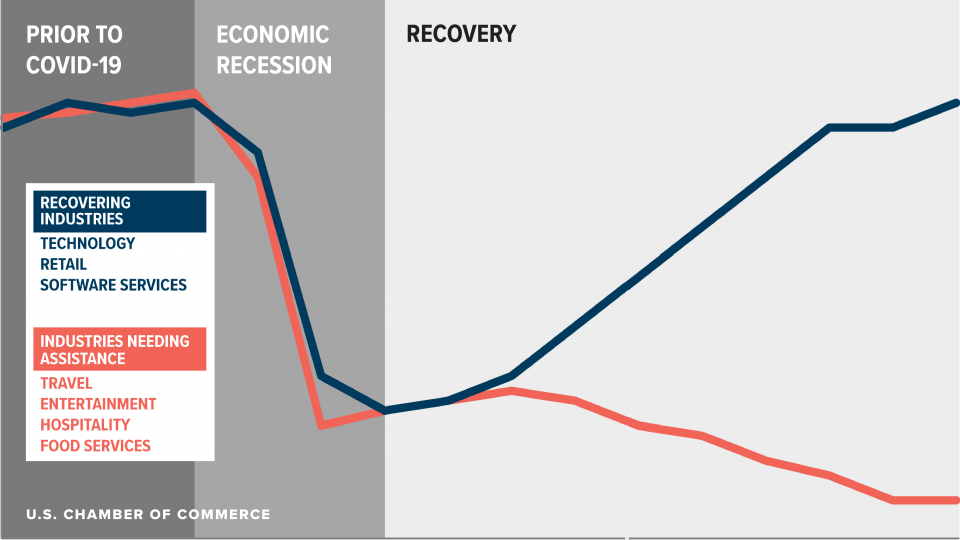
First: the economy is splitting. The bottom 99% are buying cheaper versions of everything. The top of the curve is spending more than ever on things that matter to them. Luxury goods. Boutique food products. High-end niche goods they can't find locally. If there's demand at the top of a K-shaped economy, someone is supplying it. That someone can be you.

K-shaped economic recovery — the divergence between the top and bottom arms

Second: AI just removed the 20-year requirement. The thing that used to make this world inaccessible was the infrastructure — finding buyers, finding suppliers, enriching data, doing the research to know what the price differential was between two markets. That work took decades of relationship-building and a team of analysts.

Manus AI can now do in 4 hours what used to take 3 months of cold calls. Apollo can enrich a list of 5,000 leads overnight. The barrier to entry just dropped by an order of magnitude.

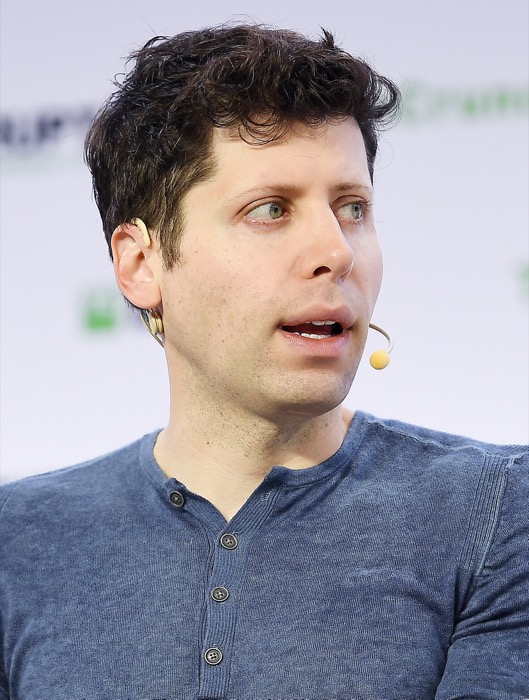
Sam Altman, OpenAI — one of the founders behind the agentic AI moment

Here's the part nobody says out loud: the tools to find the deals exist now. The tools to run the deals don't. Brokers are putting together billion-dollar conversations through WhatsApp threads and spreadsheets. That's the gap. We'll get to what we're building underneath it. For now, just know it's the reason the window is open and the reason it won't stay this way for long.

The window won't stay this open. It never does. But right now, a 19-year-old with AI tools, a few good connections, and a boutique product in their market can compete with people who've been doing this for 30 years. That's new. And it won't last.

There's already a community doing this

1,000+ brokers, suppliers, and buyers working live deals in the Discord right now. Free to join.

7. 2,400 members. Zero ads. Real deals happening before the software exists.

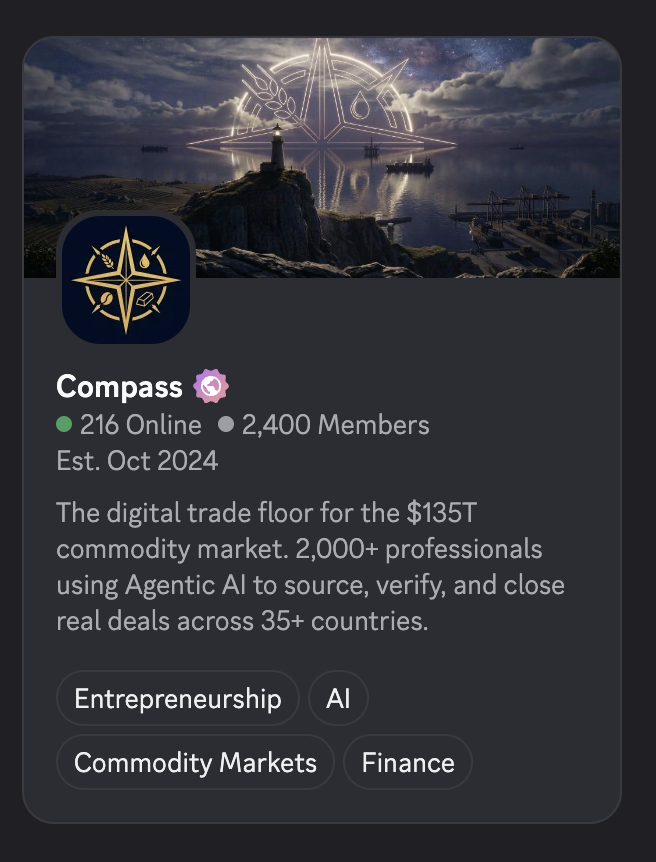
The Commodity Compass Discord didn't get here through paid ads or an influencer push. The community grew entirely from people finding the content and wanting in. It looks completely different today than it did even a few months ago — the deal flow, the geography mix, the activity level have all changed.

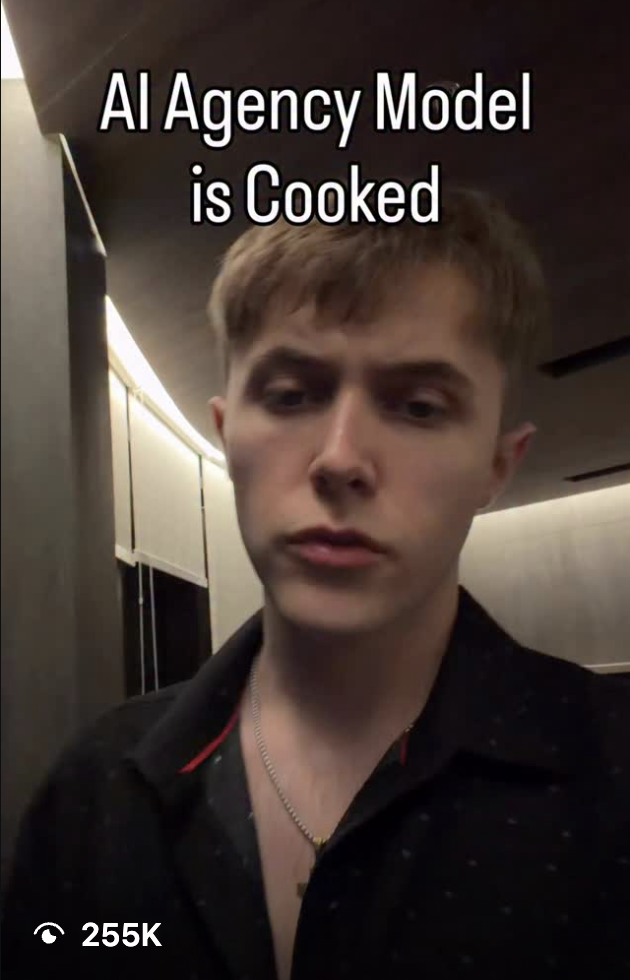
Within 24 hours of the first video going viral, the server hit 1,000 members. People from China, India, Brazil, Poland, South Africa, Vietnam, the US. Suppliers, buyers, brokers-in-training, and professionals already doing this wanting to connect with others.

Image: Discord server snapshot
Commodity Compass Discord — 2,400 members, 216 online

What happened next is what convinced me the model is right. Before any platform. Before any software. Before any formal deal infrastructure. Members started transacting in the server.

The wholesale-hub channel became a live deal room. Suppliers posting offers. Buyers posting demand. Brokers connecting them. Real commodities, real volumes, real geographies. Not hypotheticals. Actual deal flow.

Image: 255K viral reel
The viral reel that drove the initial surge — 255K views

8. What deals look like in the wild

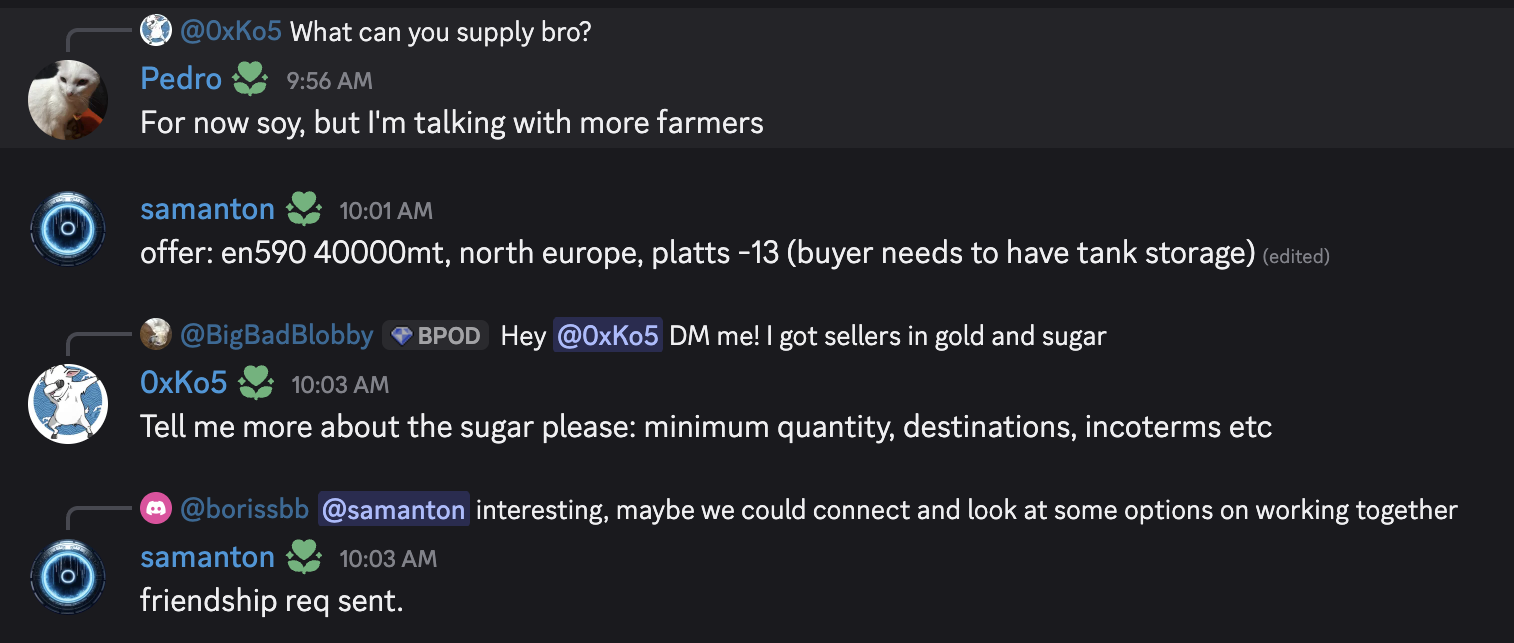
Every screenshot below is real. Every post is from a real person in the Discord server. This is what the channel looks like on a Tuesday morning.

Image: 40,000MT diesel deal thread
Discord wholesale-hub — live deal activity

That's a live 40,000 metric ton diesel fuel offer. Real specs. Real pricing indexed to Platts. The broker who posted it is based in Europe. The buyer who responded is in Madrid. They connected in the server. That's the platform working before the platform exists.

Image: South American commodities post
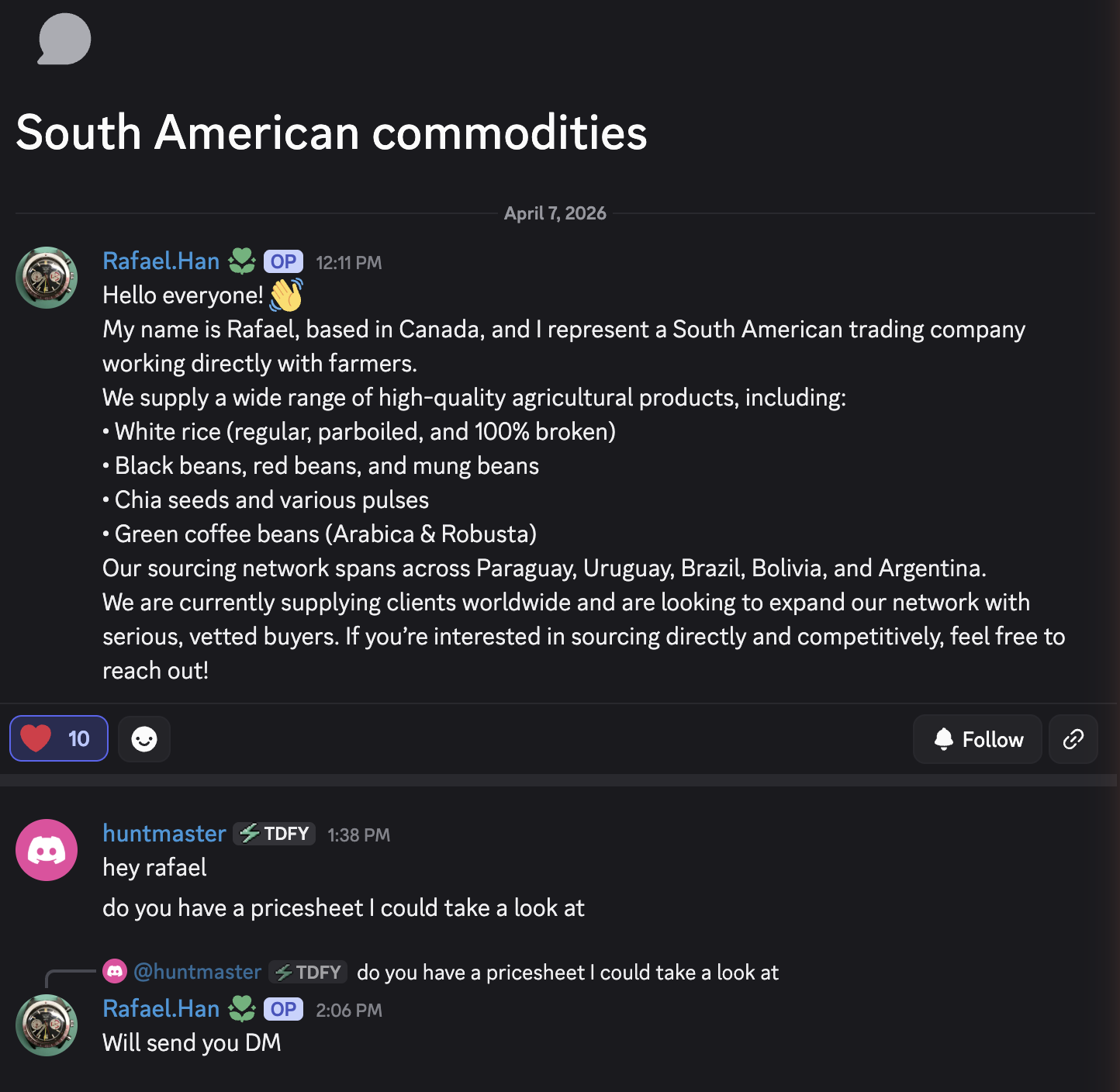
Rafael.Han South American commodities Discord post

Rafael is based in Canada but represents a South American trading company with farmer networks across five countries. He posted supply availability in the server. Within minutes, someone asked for a price sheet. That's a potential deal forming in public, in real time.

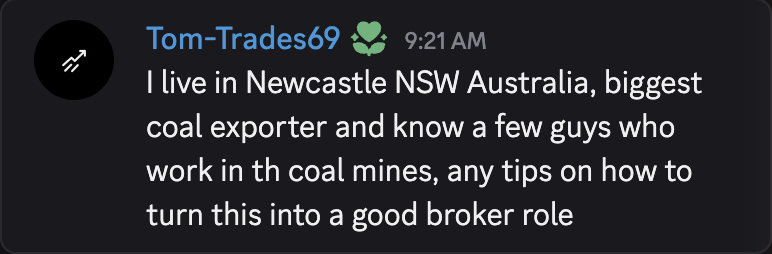
Image: Newcastle coal broker post
Newcastle coal broker post

Tom lives in Newcastle, NSW. Biggest coal exporting region in Australia. He personally knows people who work the mines. He posted: "any tips on how to turn this into a good broker role?" His geographic position alone is his entry point. He doesn't need a degree. He doesn't need capital. He just needs the model.

Now look at the inbound side. These DMs came in unsolicited after content posted to Instagram.

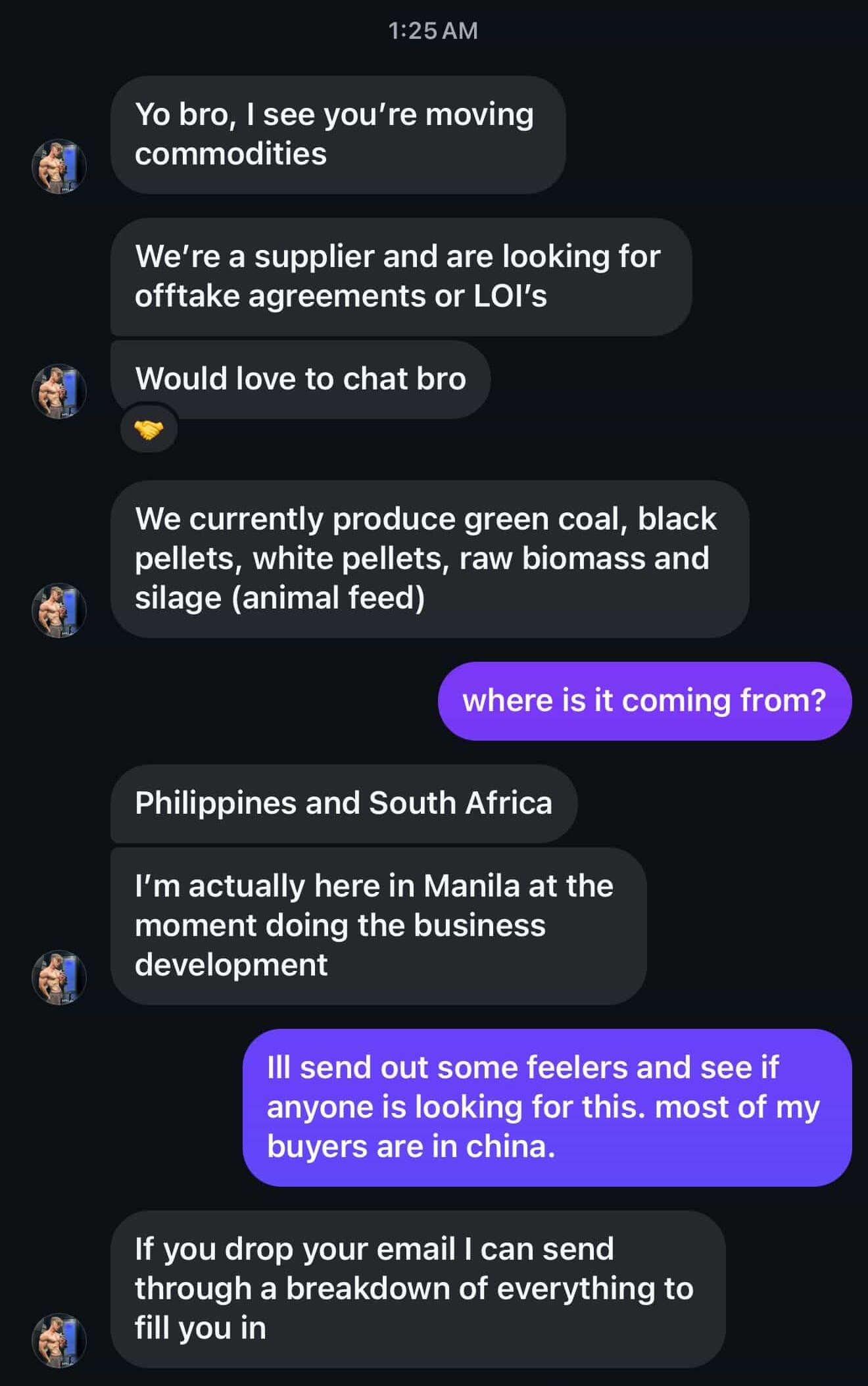
Image: Biomass supplier DM from Manila
Biomass supplier DM
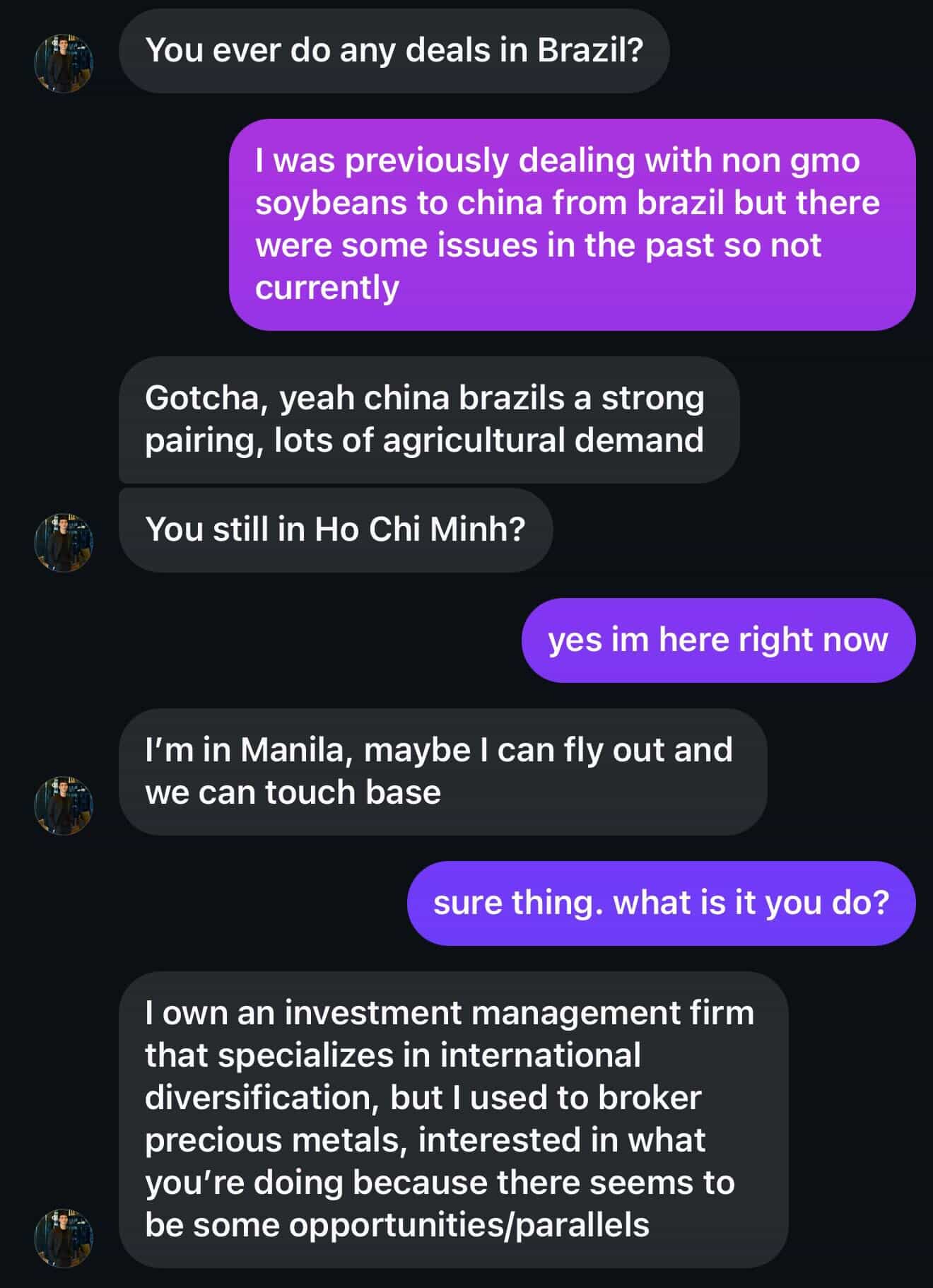
Image: Investment management firm DM
Investment firm DM

A supplier in Manila producing green coal, black pellets, and raw biomass from the Philippines and South Africa, reaching out to find buyers in China. An investment firm owner who used to broker precious metals, flying from Manila to Ho Chi Minh to meet. These aren't people found through outreach. They found Ken. His content is functioning as inbound lead generation.

9. What people are saying

The first live event drew 70+ attendees from China, India, Africa, Poland, Brazil, Russia, Vietnam, Hong Kong, Canada, and the US. These are a few of the moments that stood out.

"Can you post a video of your process? From sourcing to closing a deal?"

— Most upvoted question from the first live event, 70+ attendees
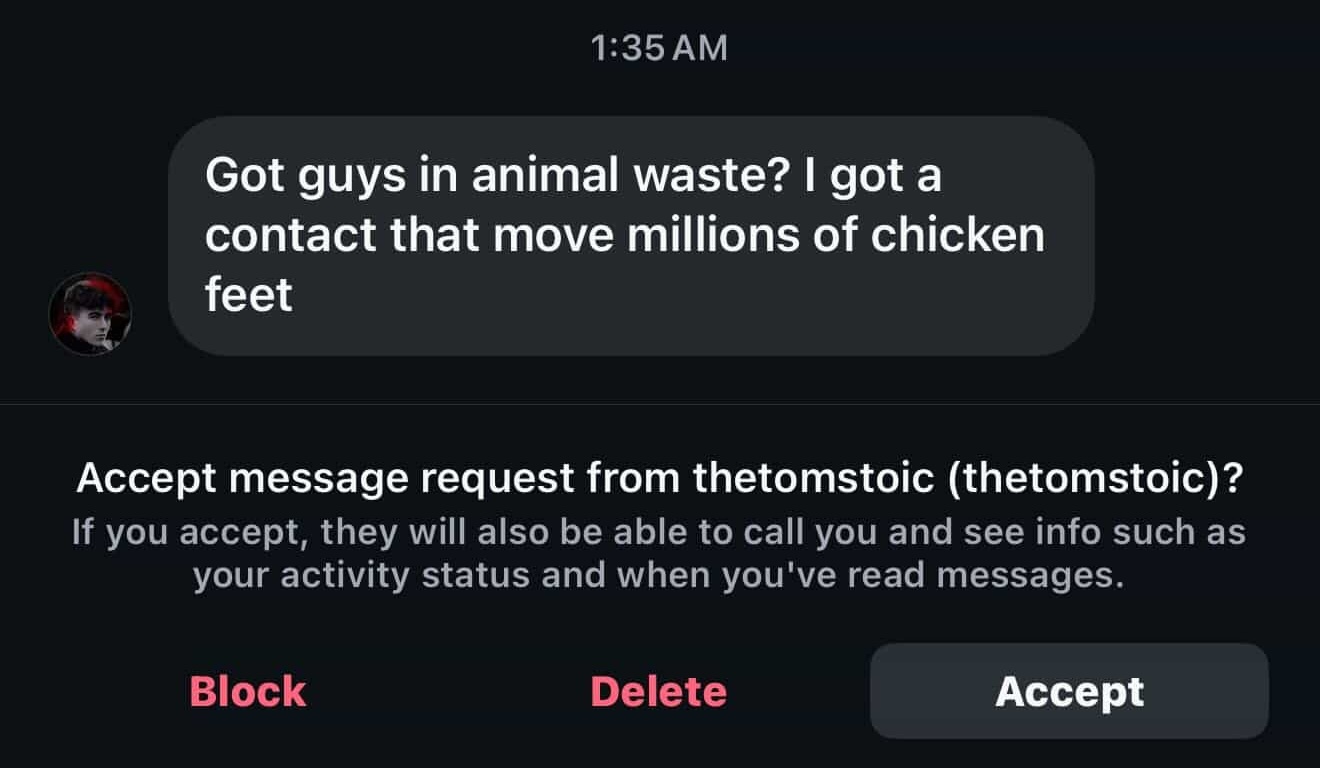
Image: Inbound DM — chicken feet
Inbound DM — chicken feet

That one comes in unsolicited at 1:35 AM. Animal waste is a real commodity market. Chicken feet alone move hundreds of millions of dollars a year, primarily from the US and Brazil into China and Southeast Asia. The fact that someone's first thought when they see commodity brokering content is "I have a guy who moves millions of chicken feet" tells you something about how wide this market actually is.

2,400+ Members in the Discord
0 Paid to acquire them
255K Views on the first viral reel
5+ Countries with active deal flow in the server

10. Real numbers from real deals.

Before we get into the model, let me show you the actual numbers. What's been closed. What the ceiling looks like. What "modestly scaled" looks like in monthly income. Because the asymmetry of this business is the part that doesn't show up in any course pitch.

Three benchmarks at three different stages of skill. All three are real — either I closed them, watched someone in the community close them, or they're documented in the broker market with publicly known operators.

10.1Tier 1 — First boutique deal: $25-50K

Realistic first-year expectation for a serious broker working part-time. One commodity, one geography, one or two deals closed. The math: a $250K monthly product flow at a 12% boutique spread, multiplied by twelve months, multiplied by your share of the commission. A typical first deal nets $25-50K spread across eighteen to thirty-six months.

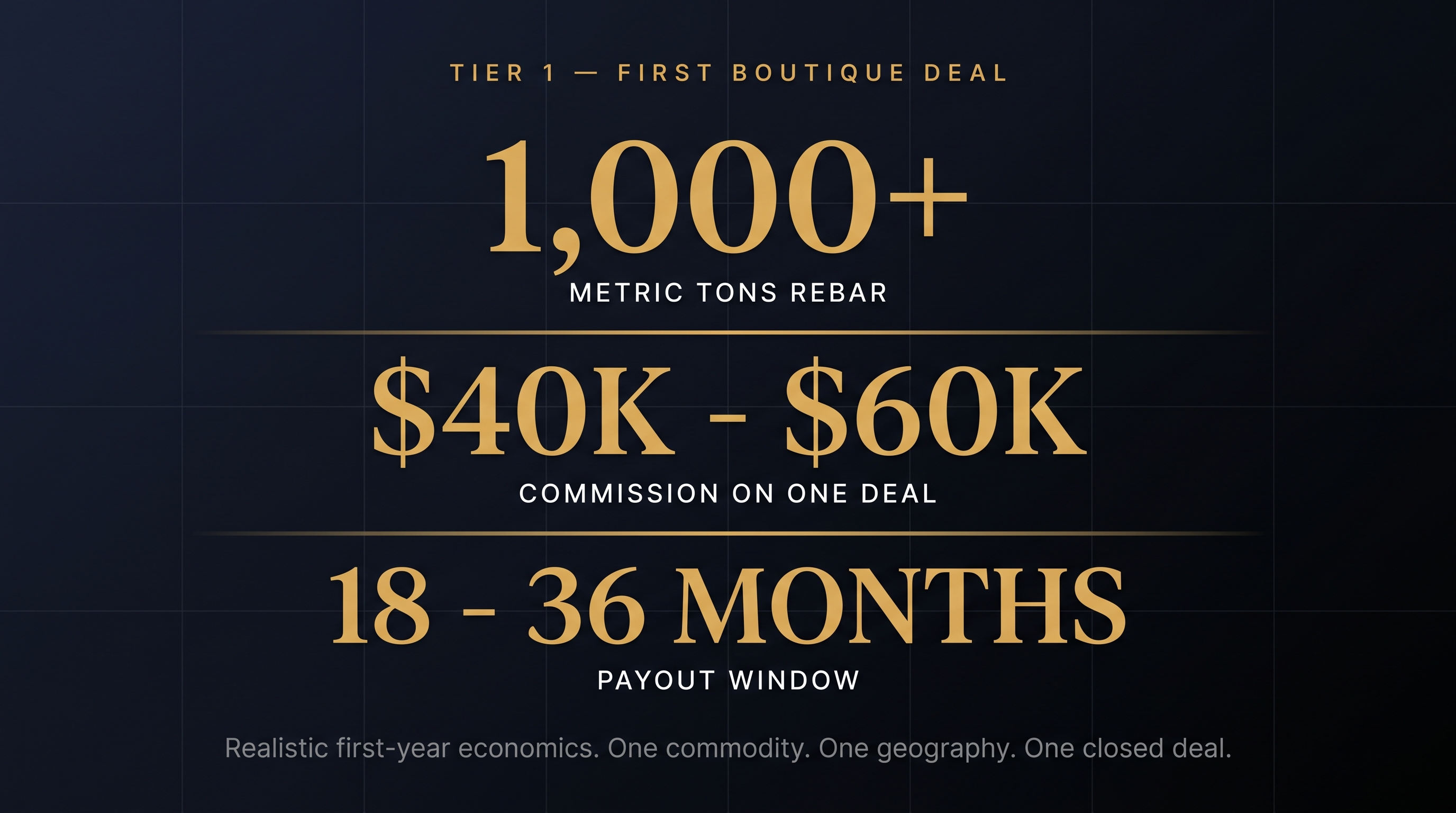
For context: the first publicly-confirmed deal in our community at the April 2026 live event was 1,000+ metric tons of rebar. Buyer sourced through the network. Supplier sourced through Manus enrichment. Single-deal commission economics: $40-60K depending on spread at execution.

Tier 1 first boutique deal — 1,000+ MT rebar, $40-60K commission, 18-36 month payout

10.2Tier 2 — Modestly scaled boutique broker: $400K-$1M

One or two commodities, working full-time, two to three years in. Multiple deals running simultaneously. The math compounds because each deal is a 36-month annuity. Here's what one boutique commodity at modest scale looks like:

Matcha deal example — one boutique commodity

$250K /month product flow through you
× 12% broker spread (standard for boutique)
× 36 months (standard contract term)
= $1.08M from one deal, one commodity, three years

That's not a projection. That's the math on a modestly-scaled matcha deal where the broker introduced a Japanese producer to a North American distributor at a 12% spread on $250K monthly volume.

10.3Tier 3 — Top of the model: $20M/year

One commodity. Sunflower oil. Ukraine. There's a broker — I won't name him publicly because he doesn't want the attention — who does this. No employees. No trading company. Finds distributors in Western Europe and Asia paying more than Ukrainian producers ask. Takes the spread. Every shipment. Every year. About $20M annually.

His operation is one man, one phone, one set of contracts. He's not doing anything magical. He found a niche where his geography (Ukraine, sunflower oil hub) and his network (Soviet-era industrial connections) created a sustainable advantage. He's been doing it for twelve years. He's not going to stop.

10.4The compounding stack

The thing that makes this model fundamentally different from agency or consulting is what happens to your income over time:

The math compounds because each deal is a 36-month annuity. Unlike an agency where you have to keep finding new clients to maintain revenue, every closed broker deal is income for the next three years. Each year you add to the stack.

The rule

The model works. The question is whether you build the pipeline to work the model. The brokers making real money aren't smarter than you — they just have more deals in motion. Ten deals in flight is a base. Three is a hobby. One is a coin flip.

Want to skip the manual research?

Compass automates the demand-finding, supply-sourcing, and contract-generation work below. Early access is open.

11. Six steps. This is the whole model.

I'm going to walk through exactly how a deal gets built, from picking a commodity to getting paid. Not a theoretical overview. The actual sequence. Every step is something I've either done personally or watched someone in the community do.

  1. 11.1

    Pick your commodity

    Most people make the same mistake here. They go after oil. Gold. Platinum. Diamonds. The big, mature markets. Don't.

    Those markets are gatekept by decades of trust-building. You're going to compete against people who've been doing this since before you were born, for buyers who've been working with the same suppliers for 20 years. The access cost is enormous and the win rate for a new independent broker is near zero.

    Boutique markets are different. High-margin, low-volume, niche commodities that aren't globally distributed yet. Things nobody's looking at. Especially the ones tied to your geography. A boutique commodity is only a real edge if you're closer to it than someone else. Sunflower oil is a fat-margin target in Ukraine. Matcha is a fat-margin target in Japan. The same commodity is a bad target when you're brokering it from a continent away with no local advantage.

    Commodity type Access Competition Margin Verdict
    Oil, gold, diamonds Requires existing relationships and pedigree Trading houses with 50-year networks Thin — compressed by volume Avoid
    Boutique ag tied to your geography (sunflower oil if Ukraine, matcha if Japan, specialty crops you have local access to) Open — suppliers are often looking for new buyers Fragmented — mostly small regional brokers Fat — 10-20% spreads are normal Target
    Regional luxury products Your geography is your advantage Almost none globally High — boutique always commands premium Target
    Industrial materials (rebar, steel) Medium — supplier access is easier than buyer access Moderate Lower, but volume compensates Situational

    The Ukrainian broker making $20 million a year doesn't have a company. He doesn't own any sunflower oil. He just knows which European distributors pay more than what Ukrainian producers ask. And he knows it because he's in Ukraine. Sunflower oil isn't his edge because it's a great commodity in the abstract. It's his edge because his geography and network make him the cheapest, fastest way to find that supply. That's the model. One commodity. The right geography. Every shipment.

    Your version of the same play looks different. If you're in Southeast Asia you're not competing globally on Ukrainian sunflower oil. You'd lose. You're connecting boutique agricultural products, specialty woods, and luxury niche goods from your market to buyers who can't access them without you. The principle is the same: pick the boutique commodity where your location, language, or network is the unfair advantage. That's where the spread lives.

  2. 11.2

    Find demand

    The old way was to cold-call into industries, attend trade shows, and hope someone was buying. That's dead. Here's what I actually do.

    The two-handshakes rule (the paradigm shift)

    The world has always been two handshakes from any commodity source. Someone in your network knows a producer. Someone in your city's expat community has supply-chain ties back to their home country. The connection has always been there. What's new is that AI agents can now activate that hidden network in hours instead of years. The reason this market is opening up isn't because new connections appeared. It's because the cost of finding the ones that already existed just collapsed. Internalize this. It changes everything about how aggressive you can be on first outreach.

    Manus AI — agentic research, now part of Meta

    Manus AI is the agentic research tool that makes the current workflow possible. If you've never heard of it, think of it as a swarm of AI agents that go out and execute multi-step research jobs on your behalf. They scrape. They enrich. They cross-reference and qualify. You don't babysit any of it. Meta acquired Manus earlier this year and folded it into their broader agentic stack, which is part of why it suddenly got a lot more capable. This is the tool you'd reach for today. Before our software ships and 10x's the whole loop.

    Open Manus. Tell it your starting position: your location, your language, what you have access to, what commodity you're going after, what your target is (find demand in these markets, find suppliers in these countries). Let it run. Multiple AI agents work in parallel — one scrapes, one researches, one enriches data. You come back a few hours later to a list of qualified buyers and suppliers with contact information.

    Then take that list into Apollo to enrich it further. Find the decision-maker. Find the email. Find the LinkedIn. Send a message that's specific, short, and worth reading. Something like: "You're sourcing [commodity] at [market rate]. I have access to [product] at a better price from [origin]. Worth a 15-minute call?"

    One channel to skip: SMS blasting in the US. The regulations are strict (TCPA plus carrier-level filtering), the registration overhead is real, and deliverability is bad even when you do it right. Stick to cold email and LinkedIn for first touch, then phone follow-up after they engage. Same caution doesn't apply to WhatsApp internationally — that's where most of this industry lives outside the US.

  3. 11.3

    Find supply

    Same process, opposite direction. Instead of "find me buyers in Germany for matcha," you tell Manus: "find me ceremonial grade matcha producers in the Uji region of Japan who aren't currently exporting to North America."

    Or you don't need AI at all. Tom-Trades69 in Newcastle doesn't need to search for coal suppliers. He lives next to the mines. His supply access is his geographic advantage — it's already there. He just needs the buyers and the model to connect them.

    The two-handshakes rule: you're closer to a commodity source than you think. Someone in your network knows a producer. Someone in your city's expat community has supply chain connections in their home country. The network already exists. The question is whether you know how to activate it.

  4. 11.4

    Lock in intent

    You've found demand. You've found supply. Before either side will pull out specs, share volumes, or sit down to talk paperwork, one of them is going to ask: where's the LOI?

    An LOI — Letter of Intent — is a one-page document where one party formally states "I want to buy X at Y price" or "I want to sell X at Y price." It's not legally binding the way a sales contract is. Nobody gets sued if a deal collapses after an LOI gets signed. But it's the broker's first real lever for getting both sides to stop circling and start working.

    11.4.1 — Why suppliers and end-users demand them

    Serious suppliers won't burn an hour of their staff's time pulling specs, drafting MOQs, or sourcing inspection reports for a buyer who hasn't put intent in writing. They get pinged by tire-kickers every week. The LOI is their filter. Same on the buyer side — a serious buyer won't have their procurement team negotiating with a supplier who hasn't formally stated price and terms.

    From the broker's seat, the move looks like this: as soon as you have one side warmed up, you ask the other side for an LOI to send over. The LOI unlocks the next round of work. Without it, both sides hover in "send me your specs" / "send me your price" deadlock and the deal dies of inertia.

    11.4.2 — When the other side won't write one

    Sometimes the buyer (or supplier) refuses. They want the other side's specs first. They don't want to put a number on paper before they've negotiated. This is normal. Two moves:

    • Coax them. Walk them through what an LOI is and isn't. It's not binding. It's not a quote. It's a one-paragraph statement of intent that lets the other side justify the work of pulling paperwork. Most resistance comes from people who think it's a contract. It isn't.
    • Flip the direction. If they still won't, go to your other side and have them send the LOI instead. The buyer-LOI ("we'd like to buy 1,000 MT at $X/MT FOB") is the most common, but a supplier-LOI ("we can sell 1,000 MT at $X/MT FOB") works the same way — it's still a written commitment that unlocks the next round.

    11.4.3 — What goes in it

    LOIs are short. A page or less. Standard contents:

    • The party's identification — company name, signing officer, jurisdiction.
    • The commodity and spec (e.g., "non-GMO yellow soybeans, US #2 grade").
    • The volume ("1,000 MT, with option for additional 9,000 MT over 12 months").
    • The price or pricing mechanism ("$X/MT FOB Houston" or "Platts indexed at -$5/MT").
    • The incoterm (FOB, CIF, DAP, etc. — see 11.6.3).
    • Validity period (LOIs typically expire in 7-30 days — keeps both sides honest about pace).
    • An explicit "non-binding" clause. The whole point of an LOI is signaling intent without the legal weight of a sales contract. State that in the body.

    ICC-style LOI templates exist in the same place as NCND templates. One clean template, reused per deal.

    11.4.4 — LOIs vs. protection paperwork (don't confuse them)

    Two different documents that both come up early. NCAs and NCNDs (covered next) protect the broker — they keep the buyer and supplier from cutting you out. LOIs unlock the deal — they signal one side's intent so the other side will do the work. You usually need both, in this order: get the protection paperwork signed first (so you can safely make introductions), then orchestrate LOIs between the parties to move the deal forward.

  5. 11.5

    Protect yourself

    Legal paperwork — signing the contract before any introduction

    One thing to know before this section. You're not the lawyer. You're not the financier. You don't underwrite, draft from scratch, or carry liability for either side's transaction. What you do own is making sure the right paperwork is in place before introductions happen, so neither party can cut you out. The depth below is a framework, not a daily grind — you set up clean templates once (with a lawyer's review) and reuse them for every deal.

    This is where most new brokers get killed. They make the introduction. They do the work. Then the buyer and supplier take the relationship direct and cut the broker out. You never see another dollar.

    You prevent this with three documents. Sign them before you introduce anyone to anyone. Every time. No exceptions.

    11.5.1 — NCA (Non-Circumvention Agreement)

    The base layer. The parties (buyer and supplier) agree not to go around you. If they transact directly after you introduced them, they owe you damages. Typical term: three years from the date of introduction.

    Key clauses to include:

    • Definition of "circumvention" — both direct (cutting you out) and indirect (using subsidiaries or affiliates).
    • Liquidated damages — a specific dollar amount or percentage of transaction value if circumvention occurs. Without this, you have to prove damages, which is hard.
    • Term — three years is standard. Some brokers push for five.
    • Jurisdiction — where disputes will be resolved. Pick somewhere with reliable enforcement (UK, US, Singapore are common defaults).
    • Confidentiality — supplier and buyer agree not to share each other's identity with third parties.

    11.5.2 — NCND (Non-Circumvention Non-Disclosure)

    The NCA's bigger sibling. Same circumvention protection, plus confidentiality protection. The parties agree not to share your supplier (or buyer) information with any other broker, competitor, or third party.

    Use NCND when:

    • The supplier or buyer is in a competitive market and identity leakage is a real risk.
    • You're dealing with a counterparty who routinely works with multiple brokers.
    • The deal involves IP or proprietary processes (specialty manufacturing, chemical formulations).

    11.5.3 — MFPA (Master Fee Protection Agreement)

    The contract that locks in your commission. Specifies:

    • Your commission rate (typically 5-15% depending on commodity).
    • The basis for the commission (gross transaction value, net of certain costs, etc.).
    • Payment terms (when and how you get paid — typically wire within X days of each transaction).
    • The term over which the commission applies (typically 36 months for all transactions between the introduced parties).
    • What happens if a party tries to renegotiate (you maintain rights for the original term).

    The MFPA is the document that turns "introducing two parties" into "owning a percentage of a deal flow for three years." Without it, you're a finder. With it, you're a broker.

    11.5.4 — The signing sequence (order matters)

    Here's the actual order of operations:

    1. You and the buyer sign the NCA + MFPA before you mention any specific supplier.
    2. You and the supplier sign the NCA + MFPA before you mention any specific buyer.
    3. (Optional but recommended) a tri-party MFPA when both sides are introduced — locks in commission terms and provides legal recourse if either party tries to circumvent.
    4. Only then do you make the introduction.

    This order matters because once the introduction is made, your leverage drops. Before introduction, both parties want what you have (the other party). They'll sign. After introduction, they have what they wanted (each other) and the contract becomes much harder to negotiate.

    11.5.5 — Common pushback (and how to handle it)

    "We don't sign agreements before knowing who you're representing."

    Common from buyer side. Response: "I understand. The agreement is mutual — it protects you too. Once it's signed, I introduce you to a verified supplier in [region] who can supply [volume] at [price range]. The agreement is what makes the introduction possible." If they still refuse, they're either not serious or planning to circumvent. Either way, walk.

    "Three years is too long."

    Negotiate to twenty-four months as a fallback. Don't go below eighteen. If they push for under a year, they're planning to do one deal and cut you out.

    "We want to use our own template."

    Fine, but read it carefully. Their template will favor them. Push back on circumvention definitions, term length, and damages clauses if any of those are weaker than your version.

    Where to get the templates: Standard NCA, NCND, and MFPA templates exist in ICC (International Chamber of Commerce) standard form. Search "ICC NCND template" or "ICC MFPA template." Have a lawyer review your template before you use it — a $200 review can save you a six-figure dispute. Once you have a clean template you trust, you can reuse it for every deal.

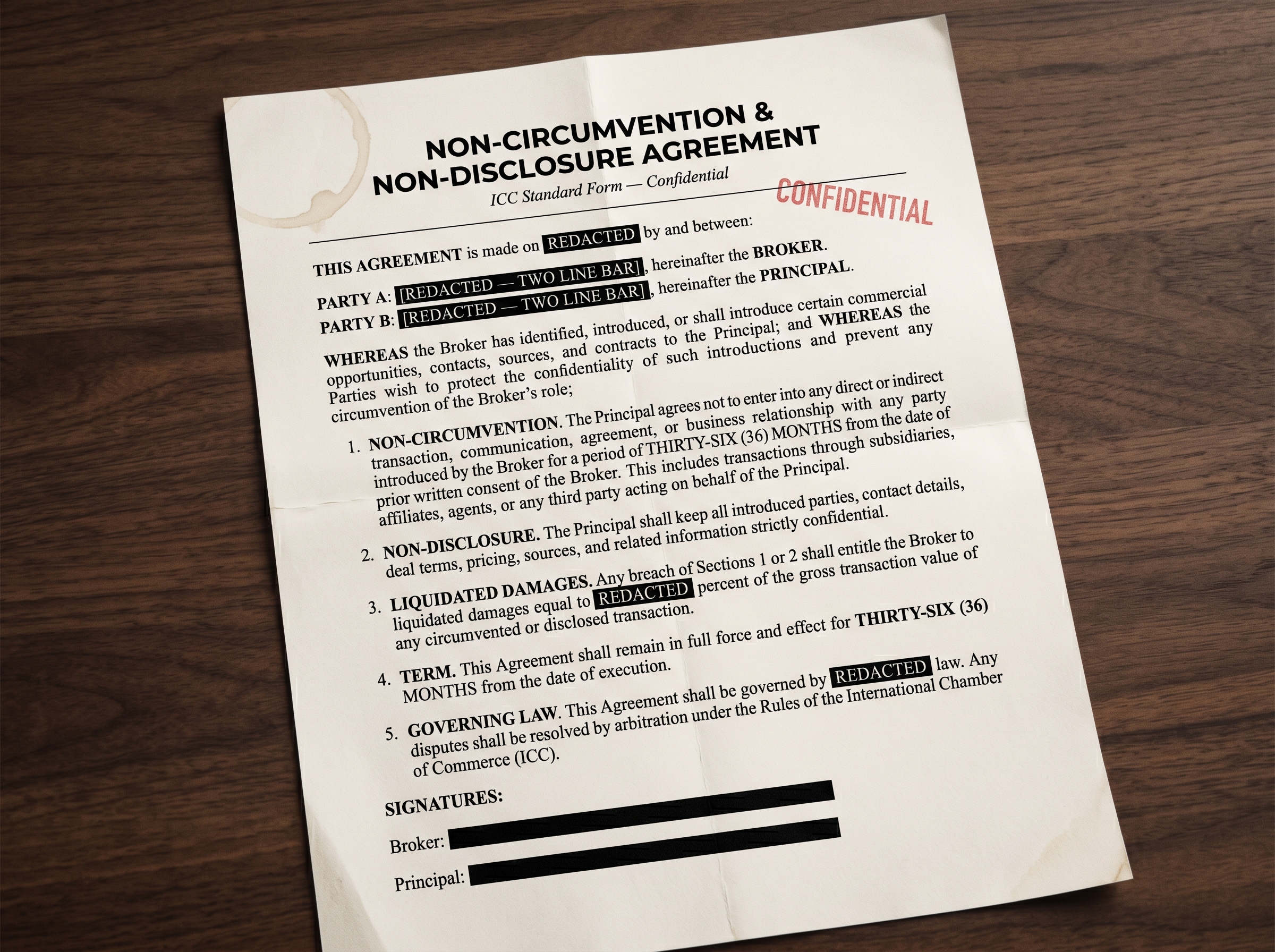
    Redacted Non-Circumvention Non-Disclosure Agreement — ICC standard form
    The Iron Rule of Brokering

    No signed protection = no introduction. No exceptions. Not for "trusted contacts." Not for "small first deals." Not for "we'll do the paperwork next week." Every time you make an unprotected introduction, you're betting your commission against the other party's character. That's not a bet you should ever take.
  6. 11.6

    Execute the deal

    Once you have a buyer interested and a supplier willing to supply, the deal becomes a negotiation of specs, price, volume, delivery terms, and payment structure. This is the part most new brokers are afraid of because it sounds technical.

    It's not as complicated as it looks. Every commodity has standard spec formats. Every trade route has standard incoterms. Every payment structure has well-defined options. You don't need to invent any of this. You learn it by doing one deal.

    11.6.1 — Specs

    Every commodity is sold against a specific specification. Soybeans aren't just soybeans — they're "US #2 yellow soybeans, non-GMO, moisture content under 13%, foreign material under 1%, broken kernels under 20%." Steel rebar is graded (Grade 60, Grade 75) with specific tensile strength requirements. Coffee has cupping scores and bean grades. Olive oil has acidity levels.

    The spec is the contract. If the spec is ambiguous, the deal will fail at delivery. Get the spec written down explicitly, in the same format the buyer's quality control team uses, before any product moves.

    11.6.2 — Volume and pricing

    Two pricing models:

    • Fixed price — locked at signing, doesn't change with market movements. Good for short deals, risky for long ones.
    • Indexed price — pegged to a published market index (Platts, LME, CBOT). Adjusts automatically. Standard for commodities with active futures markets.

    Volume is usually expressed in metric tons, with a tolerance (e.g., "5,000 MT ± 10%"). The tolerance protects both sides against over- or under-delivery.

    11.6.3 — INCO terms (delivery terms)

    Incoterms define who pays for what, where risk transfers, and what each party is responsible for. The major ones:

    Term Meaning Who Pays Shipping Risk Transfers At
    EXW Ex Works Buyer Supplier's facility
    FOB Free On Board Supplier (to port), Buyer (after) Loaded onto vessel at origin port
    CIF Cost Insurance Freight Supplier (incl. insurance to destination) Loaded onto vessel at origin (insurance covers transit)
    DAP Delivered At Place Supplier (full delivery to buyer's site) Buyer's specified location
    DDP Delivered Duty Paid Supplier (full delivery + import duties) Buyer's specified location, after customs

    The choice depends on what each party wants to handle. Suppliers often prefer FOB (their job ends at the port). Buyers often prefer DAP or DDP (they don't want to handle international shipping). Get this in writing. Ambiguity kills deals at the customs stage.

    11.6.4 — Payment structure

    Three main options, in order of supplier preference (most secure first):

    • Letter of Credit (L/C): The buyer's bank guarantees payment to the supplier on presentation of specified documents. Most secure for both sides. Banks charge 0.5-2% of transaction value. Standard for large deals ($500K+).
    • Wire transfer (T/T) with milestone structure: Buyer wires a deposit (typically 30%) at signing, balance (70%) before shipment or against shipping documents. Common for mid-sized deals. Faster and cheaper than L/C.
    • Open account (post-shipment payment): Buyer receives goods, then pays within X days. Only used between parties with established trust. Risky for suppliers — don't recommend for first deals.
    • Escrow: A third party holds funds until both parties confirm the transaction. Used when neither side trusts the other yet. Adds complexity but reduces risk.

    11.6.5 — Quality inspection

    For any deal of meaningful size, both sides usually agree on a third-party quality inspector. Major firms (SGS, Bureau Veritas, Intertek) inspect goods before shipping and certify the spec match. The certificate becomes part of the L/C document set or the wire-transfer release condition. Inspection costs are usually split between buyer and supplier or paid by buyer. Either way, build it into the deal terms.

    The things that kill deals at this stage: ambiguous specs that don't match what gets delivered, payment structure disagreements, broker chains where multiple brokers are in the middle and commissions get murky, currency mismatches without an FX clause, and customs surprises (duties, tariffs, restricted goods). Establish terms in writing before any product moves.

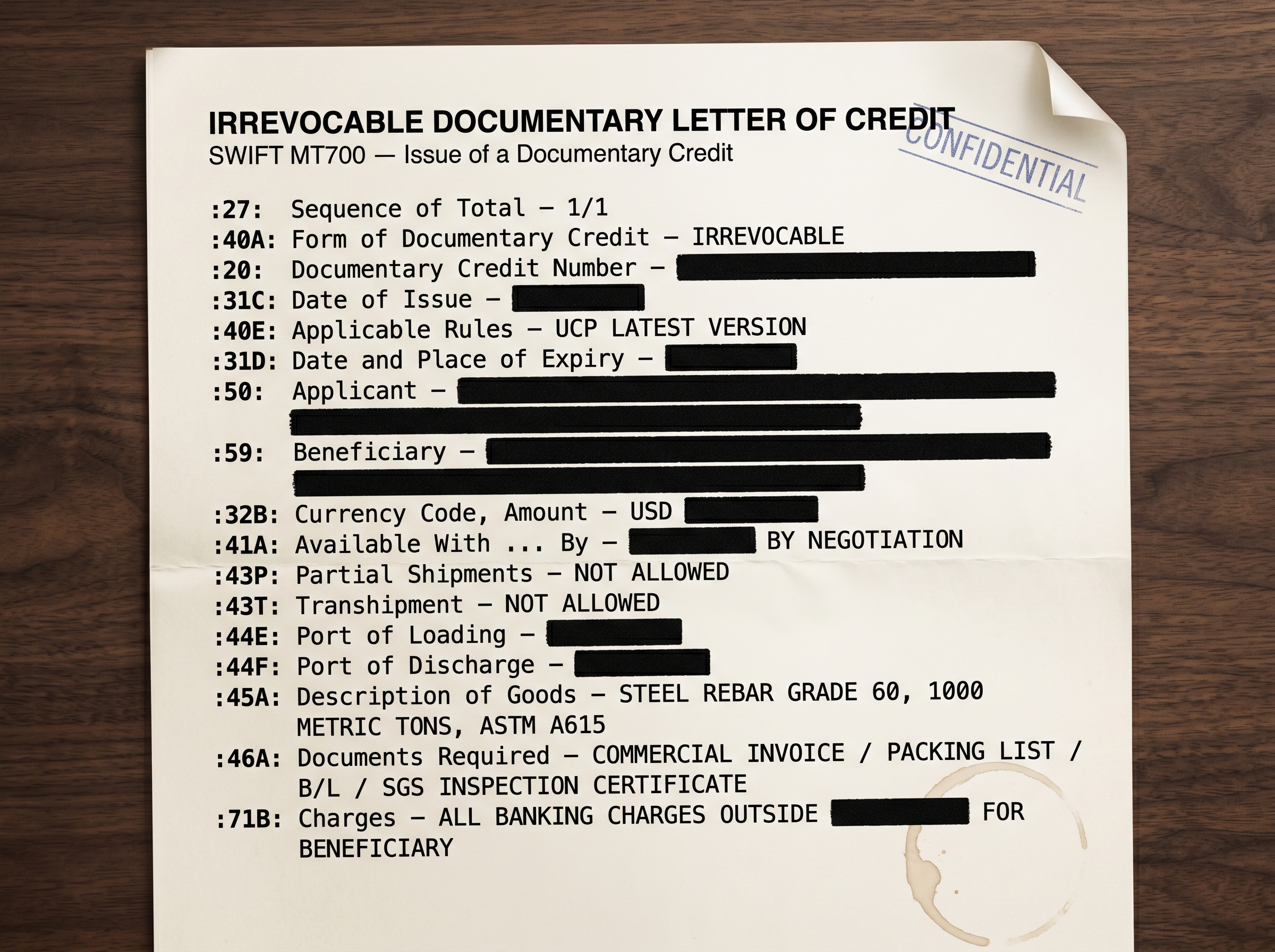
    Redacted Letter of Credit — SWIFT MT700 documentary credit format
    The Detachment Rule

    About 90% of deals fall through. Tariffs hit. A war starts. Chinese New Year freezes a month of approvals. A newly-promoted bureau official wants a fresh bribe to rubber-stamp the wire. You will sit on the edge of your seat for months on a deal that was supposed to pay you seven figures, and it will die two weeks before close. The only way to survive this game is to stop attaching to deals before they close. Build the pipeline. Run the process. Expect every individual deal to die. The ones that don't are the ones that pay you. If you can't hold that mindset, the emotional drag will burn you out long before the model has time to compound.

  7. 11.7

    Get paid

    Your commission is a percentage spread between what the buyer pays and what the supplier accepts. In boutique markets this is typically 10-15%. In mature markets it's compressed to 1-3% but volume compensates.

    Here's what the math actually looks like:

    Matcha deal example — one boutique commodity

    $250K /month product flow through you
    × 12% broker spread (standard for boutique)
    × 36 months (standard contract term)
    = $1.08M from one deal, one commodity, three years

    That's not a projection. That's the math on a modestly scaled matcha deal. One SKU. One supply chain. One contract signed once.

    I know a broker in Ukraine who does this with sunflower oil. One commodity. $20 million last year. He sends samples. He connects buyers and sellers. He makes money on every shipment. That's the ceiling this model has.

    And unlike an agency — where you stop making money the moment you stop working — the commission structure on a three-year contract means you're still getting paid on deals from 18 months ago. That's the only business model I know where you make money years after the work is done.

Two beginner questions worth answering directly

"Do brokers handle logistics, shipping, or freight forwarders?" No. The buyer or supplier handles those, depending on the incoterm you negotiate (see 11.6.3). Your job ends with the introduction, the paperwork, and the commission. You don't book containers. You don't deal with customs. You don't run trucks. If you ever want to handle logistics, you can layer it on as a separate service for an additional fee — but that's optional, not the default broker role.

"Does this only work for commodities?" No. The exact same workflow runs for plants and industrial equipment (used cement-mixing infrastructure, processing lines), off-market real assets (agricultural land, industrial parcels), and entire businesses. Find demand, find supply, lock intent, protect yourself, execute, get paid. The vocabulary changes per asset class. The model doesn't.

If you've read this far, you understand the model. The next question is what the people actually running this model wish they had. That's the rest of this page — and that's where everything we're building comes from.

12. The things that waste your time

Most people who try commodity brokering don't fail because the model doesn't work. They fail because they spend six months chasing the wrong deals. Here's how to not do that.

13. The deals I lost

These aren't here to make the model look bad. They're here because pretending deals always close would be dishonest, and dishonesty is what every other person writing about this does. The risk is real. The volatility is real. These are the two deals I've lost that still hurt.

The Soybean Deal

Millions in commissions — killed by tariffs

1.2 million metric tons. Chinese state-owned enterprise buyer. US farmer supply chain. Three months of cold calls. One month of negotiation. Three signatures from closing.

Trump imposed tariffs on China. The buyer pulled out within 48 hours. The deal was dead before the ink dried on the preliminary agreements. Not because the product was wrong. Not because the price was wrong. Because a geopolitical decision made in Washington eliminated the buyer's ability to execute.

Lesson: diversify across deals. Don't ride one deal for six months. Work three pipelines simultaneously so one geopolitical event doesn't erase everything.

The Cement Plant Deal

$700-750K commission — killed by the Iran bombing

A Chinese investor network needed European wet-mixing cement plants relocated to a new market. The plants physically disassemble, ship, and reassemble in shell buildings. I sourced the plants using Manus, negotiated the terms, and was two weeks from closing.

The US bombed Iran. Regional supply chain disruptions cascaded. The receiving market became untenable for the investment timeline. The deal died.

Lesson: understand the geopolitical exposure of every deal. If your deal touches a region with active conflict risk, price that risk into your timeline expectations.

Both of those deals were real. The money was real. The work was real. And the losses were real. That's commodity brokering. It's not a course with a guaranteed outcome. It's a business with real risk and real ceiling. The ceiling is much higher than anything I did before it.

14. Common scams & red flags

Where there's money, there are scams. Commodity brokering attracts a specific set of bad actors who target new brokers because new brokers are eager and don't yet recognize the patterns. Here are the most common, and how to spot them.

14.1The Phantom Supplier

The setup: Someone posts in a Discord or sends you a DM offering an unbelievable deal. Diesel fuel at 30% below Platts. Gold at 40% below spot. Volume in the millions of metric tons. Eager to move "this week."

How to spot it:

The play: They're not real. Either they don't have the product, or they're trying to get you to introduce a buyer who they then disappear with after taking a deposit. Walk away.

14.2The Fake Buyer

The setup: Someone claims to represent a major buyer (Aramco, Sinochem, Cargill). They want introductions to suppliers urgently. They have signing authority. They're willing to skip the standard verification process "because they're an established player."

How to spot it:

The play: They're trying to get supplier names and direct contact info to circumvent you and any other brokers. Verify the buyer through the actual corporate channel before any introduction. Real buyers from major firms have @[company].com emails and will do a video call with cameras on.

14.3The Advance Fee Fraud

The setup: A "supplier" or "buyer" needs you to pay a "performance bond" or "registration fee" before the deal can close. Could be $5K, $50K, $500K. Often dressed up as a customs requirement, regulatory deposit, or "good faith deposit."

The play: Brokers don't pay fees in deals. Period. The buyer pays the supplier; the supplier pays your commission. If anyone is asking you to pay anything to make a deal happen, it's a scam.

14.4The Broker Chain Trap

The setup: Someone introduces you to a "deal" where you're broker #4 in a chain. Broker #1 represents the actual buyer. Broker #2 and #3 are intermediaries. You're being asked to find a supplier for what's already an opaque transaction.

How to spot it:

The play: Even if the deal is real, the economics don't work. By the time the spread is split four ways, your commission is pennies. And enforcement of contracts in a multi-broker chain is nearly impossible. Walk away. Find your own deals.

14.5The Fake Letter of Credit

The setup: A "buyer" sends you a letter of credit document to prove they're funded. The L/C looks real. You introduce them to a supplier. The supplier ships product. The L/C turns out to be fake or unverifiable.

How to spot it:

The play: Always verify L/Cs through your own bank or a third-party trade finance specialist. Never accept an L/C document at face value, especially from an unfamiliar bank.

14.6The general rule

If it sounds too good

If a deal sounds too good to be true, it is. Real commodity deals are slow, paperwork-heavy, and involve verifiable parties. Anyone trying to move fast, skip documentation, or avoid verification is either incompetent or a scammer. Either way, walk away.

Your reputation in this market compounds. One scam deal that goes wrong follows you. Be selective, be slow, be verified. The good deals are still there next month.

Read those last three sections honestly. The geopolitics. The deals lost. The scams. That's what commodity brokering looks like without infrastructure — spreadsheets, WhatsApp threads, gut instinct, and luck.

Every one of those failures has a software shape. A way the deal could have been structured, verified, or pulled out of earlier if the right tool existed. That's not theory. It's the design brief for what we're building.

The next part of this page is the picture of what's broken about brokering in 2026, and how we're actively attacking it.

This is where the rebuild starts

Suppliers, buyers, and brokers in the Discord already working real deals — and shaping what we build next.

15. What brokers are working with right now

Here's an honest picture of the toolset independent commodity brokers are using today. It's not pretty.

WhatsApp groups

The primary coordination layer for deals. Buyers, sellers, and broker chains all negotiating in group chats. No verification. No structure. No contract generation. Just DMs.

Spreadsheets

Deal tracking, lead lists, commission calculations. Built from scratch by every broker independently. No standardization. No shared infrastructure.

Bloomberg Terminal

$30,000/year. Built for institutional traders. Requires a finance background to operate effectively. Not built for independent brokers. Not used by anyone building from scratch.

Manus + Apollo (advanced)

The current best stack for finding demand and supply. Two separate tools, manual coordination, no commodity-specific context built in. Better than nothing by a lot. Not a system.

The infrastructure gap isn't a small problem. It's the reason this industry has been gatekept. The people who built the relationships 30 years ago didn't need software. The information lived in their heads and their Rolodex. The new generation has AI for finding leads but nothing built for the full brokering workflow.

16. The layer that doesn't exist yet

There is no platform built for what independent commodity brokers actually need. Not one.

Bloomberg is for institutions with analysts and a $30K annual budget. Alibaba is for buyers sourcing known products from known suppliers, not for independent brokers matching undiscovered demand with undiscovered supply. Fiverr and Upwork are for services, not physical commodities. Trade finance platforms assume you already have the relationships and just need the paperwork.

What doesn't exist is a platform built around the parts that actually break deals. Counterparty verification you can trust. A way to move money without waiting three weeks on a bank LC. Escrow that holds when one side gets cold feet. The matching-and-finding piece is already getting easier — AI tools handle a lot of it now. The hard part is everything that happens after both sides say yes. The trust layer. The financial layer. The infrastructure that turns "we have a deal" into "we got paid."

That's what we're building.

17. What Compass does

Compass is the platform built for the world we just walked through. The one where the deals are real, the gaps are everywhere, and every part of the workflow — finding the deal, verifying the counterparty, closing it safely — runs on duct-taped tools.

We're building the platform that runs the workflow end-to-end with you. AI scans markets for the gaps worth moving on. Verification checks who you're really dealing with before you commit. Safer payment flows protect both sides when the money moves. The parts that have always been pure friction — verification, trust, the financial layer — get handled by the software. The parts that are the actual broker's job — finding the angle, working the relationship, knowing when something feels off — stay yours.

Find the gap

AI scans markets continuously. Real trade data, price differentials, demand signals — not historical indexes. Live, actionable gaps where you can move.

Verified counterparts

Identity, assets, deal history, track record — all verified before introduction. Counterparty fraud is the single biggest thing that kills boutique deals. Compass solves it before money or product moves.

Close the deal safely

Deal structure guidance. Contract generation. Spec and document verification. Safer payment and escrow flows when it's time to move money. The platform walks you through what used to require 20 years of experience to know — and protects both sides while the deal closes.

Image slot: Compass product UI mockup
NEEDED: Product mockup showing the Scan/Match/Execute interface. Drop when design is ready. Can use Figma export or Canva design.

Five tiers, designed not to price out the people this was built for:

TierPriceFor
Free$0 foreverWatch the globe — see live deal flow, learn the market
Starter$49/moPost deals, find counterparties, basic profile
Pro$149/moFull platform for active brokers — verified profile, contract generation, AI matching
Business$349/moAI co-pilot runs your desk — automation, pipeline, advanced sourcing
EnterpriseCustomInstitutional desks — custom integrations, white-label options

The software is in development. Early access users will shape what it becomes.

18. Your first 30 days

If you commit to this seriously, the next thirty days will set the foundation for the next three years of broker income. Here's what each week looks like.

18.1Week 1 — Research & Pick

Goal: end the week with one chosen commodity, one identified geographic edge, and a research-grade understanding of who buys it and who supplies it.

18.2Week 2 — Outreach

Goal: end the week with at least 100 cold messages sent across both supply and demand sides. Aim for 5-15 responses.

18.3Week 3 — First Conversations

Goal: have 5-10 first calls. Identify which deals are real and which are time-wasters. Sign at least one NCA.

Every first call has the same goals:

  1. Verify the party is real. Real company, real role, real authority.
  2. Understand the specific need or capacity. What volume? What spec? What timeline?
  3. Understand their decision process. Who else is involved? What's the timeline?
  4. Set up the next step. Either you're moving toward an NCA or you're not. Don't leave it ambiguous.

If everything checks out: send the NCA before the call ends. Get it signed within 48 hours. If it doesn't check out: end the call politely. Move on.

18.4Week 4 — Building the Pipeline

Goal: have 5+ deals at different stages. At least one with both NCA and MFPA signed on at least one side.

A healthy broker pipeline at the end of Week 4 should have deals at multiple stages:

Cold
50-100
Warm
5-15
Qualified
3-8
NCA signed
1-3
NCA + MFPA
1-2
Introduced
0-1

A healthy pipeline at end of Week 4. Each stage shrinks because real qualification is real work.

  1. Cold (just messaged) — 50-100 messages out, awaiting response.
  2. Warm (responded) — 5-15 active conversations.
  3. Qualified (had a first call) — 3-8 deals where you've verified the party.
  4. NCA signed — 1-3 deals with legal protection in place on at least one side.
  5. NCA + MFPA both sides — 1-2 deals ready for introduction.
  6. Introduced (in negotiation) — 0-1 deals where the buyer and supplier are talking.

18.5What success looks like at 90 days

If that's where you are at 90 days, you're on track. The first year is for closing 1-3 deals. The second year is for compounding into 5-10. The third year is for systematizing into a real broker operation.

The slowest fast business

This is the slowest fast business you'll ever run. The first six months will look like nothing is happening, and then a deal closes and the next eighteen months look obvious in retrospect. If you can hold the line through the slow part, this becomes one of the best businesses you'll ever run.

Before you do anything

Don't open a tab and start working on this right now. Close your laptop. Leave your phone on the desk. Go for a long walk. No music. No podcast. No calls. Let what you just read settle. Notice which parts your mind keeps coming back to. Sit with the questions in this section. What's your geography? What's your access? What's your unfair advantage? What's the one boutique commodity that fits all three? The answers don't come from rereading. They come from giving your brain the space to connect the pieces. Then come back, with your own answers, and start.

19. Glossary of terms

Every commodity deal will throw acronyms at you. Here's a working glossary of the terms you'll see most.

19.1Commercial terms

Bid / Offer / Indication
A bid is a price someone wants to buy at. An offer is a price someone wants to sell at. An indication is a non-binding signal of interest.
BL (Bill of Lading)
Shipping document that serves as a receipt for goods, evidence of contract for shipment, and document of title.
COA (Certificate of Analysis)
Lab document confirming product quality and spec. Usually issued by the supplier or a third-party lab.
COO (Certificate of Origin)
Document confirming where goods were produced. Used for customs and tariff purposes.
FOB / CIF / DAP / DDP / EXW
Incoterms — defined responsibility points in international trade. See section 11.6.3 for details.
L/C (Letter of Credit)
Bank-guaranteed payment instrument. Releases payment to supplier on presentation of specified documents (BL, COA, COO).
LOI (Letter of Intent)
Non-binding statement of intent to do a deal. Used to unlock specs and paperwork from a counterparty who won't move without seeing intent first. See section 11.4.
MOQ (Minimum Order Quantity)
Smallest deal size a supplier will accept.
NCA (Non-Circumvention Agreement)
Contract preventing parties from going around you after introduction. See section 11.5.1.
NCND (Non-Circumvention Non-Disclosure)
NCA plus confidentiality. Used when identity protection matters.
MFPA (Master Fee Protection Agreement)
Contract locking in your commission rate and term. See section 11.5.3.
POF (Proof of Funds)
Document showing the buyer has the financial capacity to execute the deal.
POP (Proof of Product)
Document showing the supplier actually has the inventory to fulfill.
SBLC (Standby Letter of Credit)
A type of L/C used as a payment guarantee, drawn only if the buyer fails to pay through other channels.
SCO (Soft Corporate Offer)
Initial supply offer with non-binding pricing. Typically the first formal document in a deal.
SWIFT
Society for Worldwide Interbank Financial Telecommunication. Global messaging system for international wire transfers.
T/T (Telegraphic Transfer)
Wire transfer. Standard alternative to L/C for smaller deals.

19.2Market terms

Spread
Difference between bid and offer. Your commission is essentially a structured spread.
Platts
Major commodity price reference index, especially for energy products. Pricing often expressed as "Platts +/- X."
LME (London Metal Exchange)
Reference market for non-ferrous metals.
CBOT (Chicago Board of Trade)
Reference market for agricultural commodities.
Long / Short
Long means you have inventory or a buy commitment. Short means you owe delivery or have sold without supply.

19.3Process terms

Soft Probe
Initial outreach to gauge interest before formal documentation.
Performance Bond
Deposit ensuring deal performance. Usually held by an escrow agent. NOT something you (the broker) should ever pay.
Demurrage
Cost of cargo sitting at port beyond the allowed free time. Usually paid by the party causing the delay.
Inspection at Loading / Discharge
Quality and quantity check by a third-party inspector at origin or destination port.
Rolling Contracts
Long-term agreements where deliveries happen periodically (monthly, quarterly) over the contract term.

Two ways to move from here

You've read the model. You've seen the deals. You know what the infrastructure gap is and what we're building to close it. There are two ways to get involved, and both are open right now.

Door 1

Early access to Compass

The platform is in development. Early access users get first access when it launches and direct input into what it becomes. We're building this for brokers who are already working deals, not for a general audience.

If you have a commodity, a connection, or a market position and you want a tool built for how this actually works, get on the list.

Get early access to Compass
Door 2

The Discord

Free. Active. Real deal flow happening in the #wholesale-hub channel right now. 2,400+ members from 35+ countries. Suppliers posting offers. Buyers posting demand. Brokers making connections.

If you want to see how the community works before committing to anything else, this is where to start.

Image: Compass Discord
Commodity Compass Discord — 2,400 members, 216 online
Join the Commodity Compass Discord

A final word

I'm not a teacher. I'm not a speaker. I'll be the first to admit I skipped over things in this page that deserve more explanation.

But I spent four years in this market, almost made 5+ million dollars off single deals several times, closed real deals, lost real deals to tariffs and bombings, and built a community of 2,000+ people who are already moving before the platform exists.

The model works. The tools to do it yourself are finally here. What's still missing is the platform that makes it accessible to people who don't have 20 years in trading houses or the luck of meeting the right industrialist in Eastern Europe at 19.

That's what we're building. And the community we're building it with is in the Discord right now, running deals.

Get in early. The window doesn't stay open.

Ken
Founder, Compass

Ken — founder, Compass